

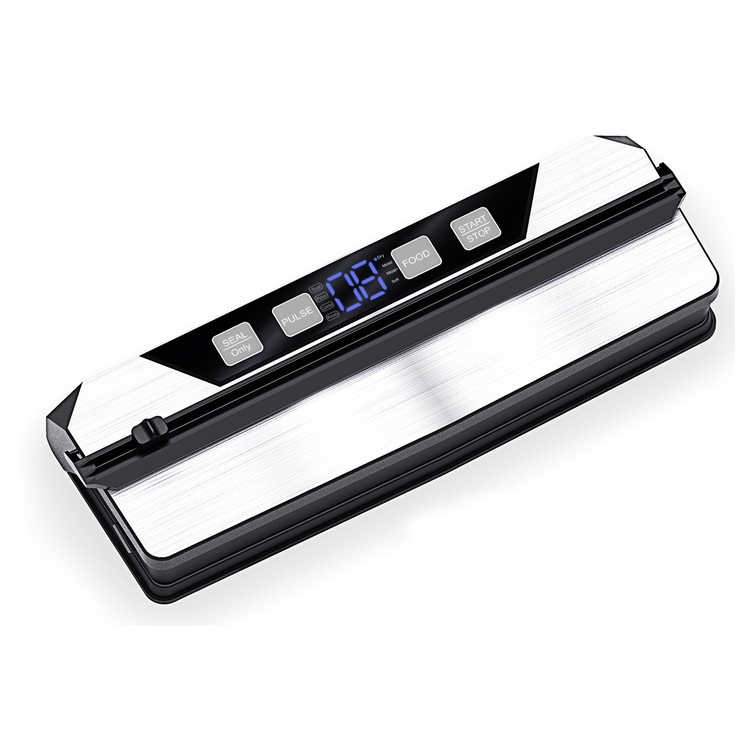
Sourcing wholesale vacuum sealers from China is straightforward once you understand how a factory actually quotes and ships an order. As an OEM/ODM manufacturer in Guilin shipping to importers, retailers, and distributors in 56+ countries, we field the same questions every week: What is the real minimum order? How is pricing tiered? How long until the goods are on the water? This guide lays out what to expect at each stage so you can plan inventory, cash flow, and landed cost with confidence.
Minimum order quantity (MOQ): what is realistic
MOQ depends on whether you want stock product or a customized build. For a standard chamber or external (out-of-chamber) vacuum sealer carrying our own model number, MOQs are low and built for first orders and test batches. For OEM/ODM work the floor rises, because tooling, branded components, and custom packaging all carry setup cost that has to be spread across units.
- Stock model, neutral packaging: small trial quantities are workable, typically a few hundred units per model.
- Logo print or custom color box: usually 500–1,000 units, since print plates and box dies have a setup cost.
- Full ODM (custom housing, control board, or tooling): 1,000+ units per model to amortize mold and engineering investment.
- Mixed container: several models can share one shipment to hit a competitive per-unit price without overcommitting to a single SKU.
If your forecast is uncertain, start with a stock model at a modest MOQ, validate sell-through, then move to a branded ODM run on the reorder. We would rather you place a clean test order than overbuy on day one.
Tiered pricing: why the unit price drops with volume
Vacuum sealer pricing is volume-banded. The per-unit cost falls as quantity rises because fixed costs—line setup, QC, packaging design, and freight consolidation—are divided across more pieces. A realistic quote shows several price breaks so you can see exactly where the next tier rewards you.
What moves the unit price
- Pump and seal spec: a single-pump external sealer costs less than a dual-pump or chamber unit with a stronger vacuum draw and wider seal bar.
- Materials: ABS housing versus stainless trim, seal-bar width, and bag-cutter or pulse-vac functions all shift cost.
- Certification: CE, FCC, UKCA, RoHS, and target-market plug types add per-unit and one-off testing cost. Tell us your destination market early so the BOM is right the first time.
- Packaging: neutral brown box is cheapest; full-color retail boxes with inserts cost more but lift shelf appeal.
Ask for the quote in tiers (for example 300 / 500 / 1,000 / 3,000 units). That way you can model your margin against MOQ and decide whether a slightly larger order unlocks a better landed cost.
Production lead times
Lead time is the gap between deposit and goods leaving the factory. For vacuum sealers it depends on stock availability of components and whether the run is customized.
- Stock models, in-stock components: roughly 15–25 days after deposit and artwork sign-off.
- Custom packaging or logo: add about 7–10 days for print proofing and approval.
- Full ODM with tooling: 35–60 days, since molds and sample approval come before mass production.
- Peak season (pre–Q4, before Chinese New Year): plan a buffer—component supply and freight both tighten.
We confirm a written ship date with every order and flag any component risk up front rather than after the deposit lands. A pre-production sample for first orders prevents surprises and is the cheapest insurance in the whole process.
Export packaging and what is inside the carton
Good packaging protects margin: damaged units in transit become returns and disputes. Vacuum sealers ship in a retail or neutral inner box, then in export master cartons sized for efficient palletizing.
- Inner box: printed retail box or plain box, with foam or molded-pulp inserts to cushion the pump and seal bar.
- Master carton: typically 4, 6, or 8 units, marked with carton dimensions, gross/net weight, and your shipping marks.
- Starter accessories: sample roll/bags and a manual in your chosen language can be packed in.
- Compliance marks: certification logos, barcodes, and country-of-origin labeling applied to spec.
Share your barcode and label requirements at PO stage so cartons are retail-ready on arrival and clear customs without relabeling.
Sea vs air freight: choosing the right mode
Vacuum sealers are moderately bulky relative to their value, so most wholesale orders move by sea. Air freight is reserved for samples, urgent restocks, or small high-margin batches.
Sea freight
The default for full orders. LCL (less-than-container load) suits smaller runs; FCL (a full 20ft or 40ft container) gives the lowest per-unit freight once volume justifies it. Transit is roughly 25–40 days port-to-port depending on lane, plus customs clearance at destination. We handle FOB from a south China port and can quote CIF or work with your forwarder.
Air freight
Fast—typically 5–10 days door-to-door—but priced by chargeable weight, so it is best for samples and time-critical top-ups rather than full pallets. For a quick market test, air a small batch while the bulk order follows by sea.
Whatever the mode, agree Incoterms (FOB, CIF, or DDP) in writing so responsibility for freight, insurance, and duties is unambiguous before the goods move.
Talk to the factory
Every order is a little different, and the fastest way to a realistic plan is a direct conversation about your models, volumes, and destination market. Browse our vacuum sealer range to shortlist the units that fit your channel, then request a quote with your target quantity and market—we will come back with tiered pricing, a firm lead time, packaging options, and a recommended shipping mode, direct from the factory with a 12-month warranty and low MOQs to start.
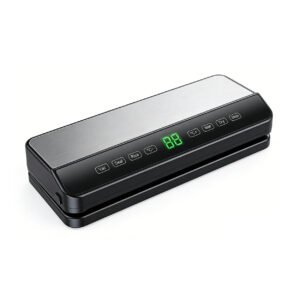
Featured model
Vacuum Sealer, 65kPa, 30 cm Seal, Roll Storage (VS-TGX4)
This vacuum sealer is made direct-from-factory and offers 65kPa and 30 cm seal, featuring roll storage, from Guilin Prime Household Products. Available OEM/ODM with low MOQ…
from $14.00
Similar products
Vacuum Sealer, 65kPa, 30 cm Seal, Roll Storage, Temp Control
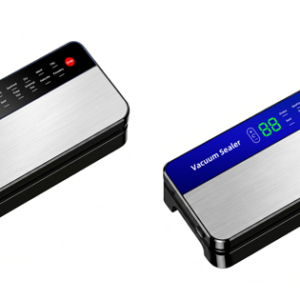
Vacuum Sealer, 70kPa, 30 cm Seal, 10 Modes, 120W
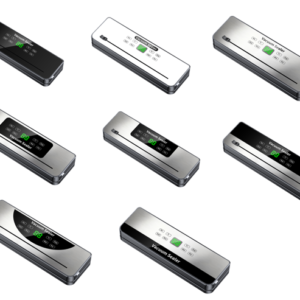
Vacuum Sealer, 75kPa, 30 cm Seal, Touch Screen, Temp Control
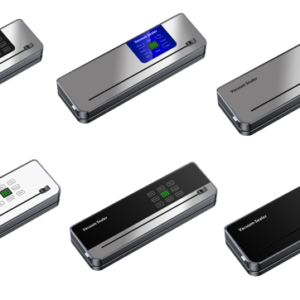
Vacuum Sealer, 75kPa, 30 cm Seal, Temp Control
Ready to order or need a wholesale quote?
Guilin Prime Household Products Co., Ltd. manufactures these vacuum sealers direct from our Guilin, China factory — OEM, private-label and B2B orders welcome. Tell us your target market and quantities for a factory-direct quote within 24 hours.